
Harran and Its "Mud-Brick Beehives": Living History on the Mesopotamian Plain
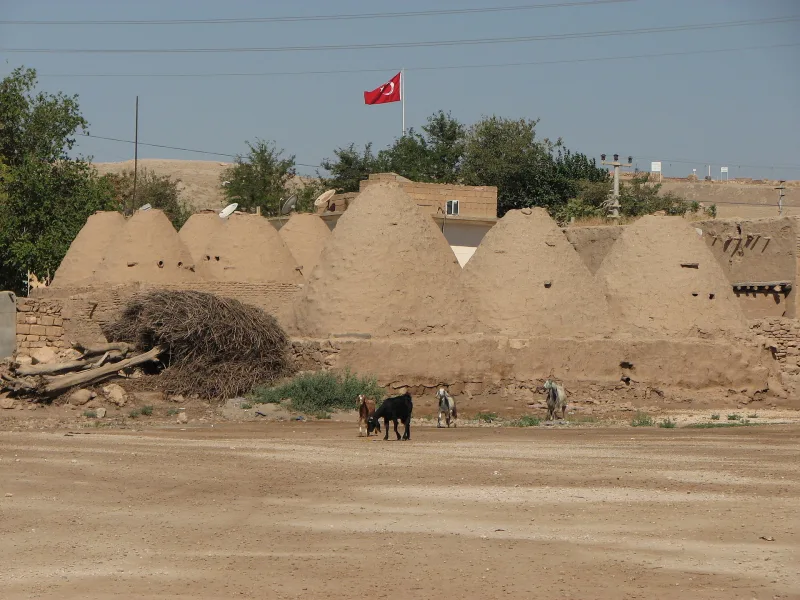
Harran is an ancient settlement in southeastern Anatolia, in the province of Şanlıurfa, just 44 kilometers south of the city of the same name and very close to the Syrian border. This small village is known not only for its history stretching back thousands of years, mentioned in the Bible and in Mesopotamian cuneiform texts, but also for a completely unique type of traditional dwelling—conical mud-brick “beehive” houses. The rounded adobe domes, clustered closely together, create the impression that you are looking at a set for a film about the Ancient East or a fairy-tale town transported from the depths of centuries past. Harran is on UNESCO’s tentative list and remains one of Turkey’s most atmospheric and unexpected destinations for travelers seeking off-the-beaten-path experiences.
History and Origins
Harran is one of the oldest continuously inhabited places on the planet. The first mentions of it appear in cuneiform texts from Ebla, Mari, and Assyria as early as the 3rd millennium BCE. In the Old Testament, Harran plays a key role as the city where the family of the patriarch Abraham temporarily stopped on their way from Ur of the Chaldeans to the land of Canaan (Gen. 11::31). According to tradition, it was here that Abraham heard the voice of God calling him to set out on his journey, and it is here, according to one account, that his father Terah was buried. These biblical associations have made Harran an important place of remembrance for Judaism, Christianity, and Islam alike.
In ancient times, Harran was known as Carra and associated with the moon god Sin, whose cult flourished here until the late Roman period. It was near the city in 53 BCE that the famous Battle of Carrhae took place, in which Parthian archers routed the army of the Roman commander Marcus Licinius Crassus—one of Rome’s greatest defeats in the East. During the early Islamic period, Harran became a major center of learning: in the 8th–9th centuries, the first Islamic university operated here, where Greek philosophical and medical treatises were translated and renowned Sabian scholars, including Sabit ibn Qurra, taught. In the 13th century, the city was destroyed by the Mongols and never regained its former importance.
Modern traditional “beehive” houses did not appear in Harran until the 18th–19th centuries, though their structural principle has its roots in the much older treeless regions of Northern Mesopotamia and Syria, where wood was a scarce material. The use of building stone and clay allowed local residents to construct domed ceilings without the need for beams.
It is believed that it was the Arab and Turkmen tribes, who migrated in the 18th–19th centuries from the deserts of Syria and Upper Mesopotamia, who brought here the tradition of “kumbet-evleri”—dome-shaped dwellings adapted to the hot, dry climate. Since then, this architectural style has become firmly associated in the minds of travelers with Harran, although isolated examples of such structures can also be found in neighboring villages of Southeastern Anatolia. In the 20th century, with the advent of modern construction (concrete, steel beams, iron roofs), most of the beehive houses were converted into non-residential or auxiliary structures; however, thanks to their protected status and tourist interest, some of them were preserved and restored. Today, one of the residential clusters in the center of Harran functions as a “living museum,” where visitors can see a traditional interior with carpets, pillows, wooden chests, and farming tools, as well as sample sweet local tea served in glass armud cups.
What to See and Architecture
Harran is compact and can be explored on foot in a few hours. The short distances between attractions allow you to plan an interesting route, and the combination of ruins and a living village makes the trip particularly memorable.
Kumbet-evleri — beehive houses
Harran’s main attraction is a group of conical houses built from mud bricks and covered with a smooth clay mortar. Each house consists of several “hive” sections, each topped by a dome built without a single nail. The dome gradually tapers upward thanks to the bricks being laid slightly inward, creating a perfectly functioning natural ventilation system: it stays pleasantly cool inside in the summer and warm in the winter. Some of the houses are still used by residents, while others have been opened as mini-museums and ethnographic houses, where visitors are shown traditional daily life, offered tea, and invited to take photos in local costumes.
Daily Life Inside the Dome Houses
When visiting an ethnographic “beehive” house, you’ll have the opportunity to see exactly how the interior space of such dwellings is organized. Typically, a single house consists of several interconnected domed rooms, each serving a specific function: a guest room, a bedroom, a kitchen, and a pantry. The floors were traditionally covered with rugs and kilims, the walls remained whitewashed, and a low table with cushions along the walls took center stage. It is particularly impressive how five or six people could fit in a single small room at the same time, and the coolness inside contrasted with the sweltering heat outside. The hosts are happy to show off chests containing dowry items, a home loom, and antique utensils, thereby offering a chance to experience the living tradition of Kurdish-Arab rural life.
The Great Mosque of Harran
In the center of the village stand the ruins of Ulu Camii (the Great Mosque), one of the oldest stone mosques in Anatolia. It dates back to the 8th century, the Umayyad era. Of the original building, the distinctive square minaret, parts of the walls, the mihrab, and several columns have survived. This mosque is considered one of the oldest Islamic religious structures in Turkey and serves as a reminder of Harran’s past as a center of learning.
The Fortress and the Ancient University
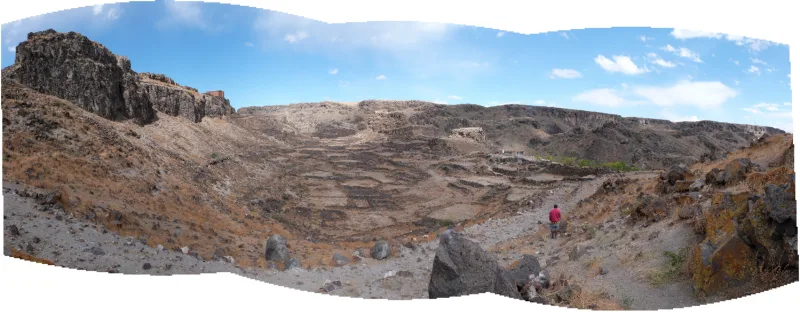
In the eastern part of the settlement lie the ruins of the Harran Fortress and the so-called first Islamic university—imposing walls and arches preserved among the desert hills. The preservation is fragmentary but picturesque, and combined with the low earthen ramparts, they give an idea of the scale of the medieval city.
Temple of the Moon God Sin
One of the symbols of ancient Harran was the Temple of the Moon God Sin, which had stood here since Assyrian times. In the city of late antiquity, this cult persisted longer than in any other center in the Middle East: the inhabitants of Harran, known as the Sabians, continued to worship the heavenly bodies even during the early centuries of Islam, and their scholars actively translated Greek and Persian astronomical texts. Archaeological excavations at the site have revealed the foundations of temple platforms and steps, which researchers believe may have belonged to this very famous sanctuary. Information panels on site explain exactly where the main sacred structures of the ancient city were located.
Ancient Tell-Shaped Hill
In the center of the modern village lies an ancient archaeological tell—a multi-layered mound where archaeologists have uncovered traces of Assyrian, Babylonian, and Hellenistic periods. Some of the finds from the excavations are on display at the Şanlıurfa Archaeological Museum.
Interesting facts and legends
- Harran is mentioned in the Book of Genesis as the place where Abraham’s family temporarily settled; this biblical connection makes the city a place of pilgrimage for believers of the three monotheistic religions.
- The beehive-shaped houses provide such effective thermal insulation that inside them, during the day in summer, it can be 10–15 °C cooler than outside.
- According to tradition, the first university in the history of Islam was founded in Harran as early as the 8th century, long before Al-Qarawiyyin in Fez.
- The astronomer and mathematician Thabit ibn Qurra, one of the greatest scholars of the medieval East, was a native of Harran; his translations and commentaries on Euclid, Archimedes, and Ptolemy played a key role in preserving ancient knowledge.
- During the Battle of Carrhae in 53 BCE, one of the first Roman legionary eagles was lost, which was considered Rome’s greatest disgrace and served for decades as a motive for campaigns of revenge.
How to get there
The easiest way to reach Harran is from Şanlıurfa—a major city in Southeastern Anatolia with its own airport (GNY). The distance from the center of Şanlıurfa to Harran is about 44 kilometers along a well-paved highway; the drive takes approximately 45 minutes. You can hire a taxi on a waiting basis, rent a car, or join a day trip from Şanlıurfa, which often includes visits to Göbekli Tepe, Harran, and the ancient city of Suayb. Public transportation consists of infrequent dolmuş minibuses; however, for independent travelers, private or tour agency transportation is the most convenient option. In the center of Şanlıurfa, it’s easy to arrange a half-day or full-day trip with a driver—many taxi drivers are happy to take tourists for a fixed fee and act as impromptu guides. Some boutique hotels in Şanlıurfa’s historic caravanserais offer their own transfers and pre-planned itineraries through Southeastern Anatolia, which makes planning much easier on a first visit to the region.
Tips for travelers
The best time to visit Harran is spring (March–May) and fall (October–November). Southeastern Anatolia is famous for its extremely hot summers, when temperatures exceed 40 °C and in some places rise to 45–47 °C; it is best to plan summer trips for either the very early morning or sunset to avoid the midday heat. Winters here are relatively mild, but rain and strong winds are common, and the mud-brick houses are not designed to withstand prolonged exposure to heavy rain.
Plan to spend two to three hours visiting Harran: this will be enough time to explore the “beehive” houses, the Ulu Camii Mosque, the fortress, and the archaeological mound, drink traditional tea in the ethnographic house, and chat with the locals. Be sure to bring water, a hat, sunscreen, and comfortable shoes. Many beehive houses operate on the basis of voluntary donations or a nominal fee for tea and photo sessions—keep small bills on hand. Women in Harran, as in many traditional villages of Southeastern Anatolia, are advised to wear more modest clothing, especially when visiting the mosque.
Harran pairs perfectly with a visit to Göbekli Tepe and the old city of Şanlıurfa as part of a single itinerary—all three sites effectively form a single tourist axis in Southeastern Anatolia. Keep in mind that the current opening hours of the ethnographic houses and the security situation in border areas change periodically, so it’s worth checking official recommendations and consulting with local travel agencies before your trip. If you have the chance to stay longer, be sure to visit the nearby village of Suayb, which, according to legend, is associated with the prophet Shuayb and has preserved impressive ruins of Roman and early Islamic houses, as well as the ancient city of Sumtar, hidden in the fields a few kilometers from Harran. This itinerary transforms the trip into a full immersion in the region’s multi-layered history: from Mesopotamian tell sites and biblical legends to the Arab scholarly tradition and 20th-century Kurdish peasant life. In Şanlıurfa, meanwhile, it’s worth setting aside a day to stroll through the central district, featuring the sacred Balykli Göl ponds, Abraham’s Cave, the Kapalı Çarşı covered market, and the Archaeological Museum, which houses finds from Göbekli Tepe and Harran itself. With proper planning, Harran, with its mud-brick hives, becomes one of Turkey’s most photogenic and truly unique attractions and invariably makes it onto personal lists of “the best places in Southeastern Anatolia.”